
Checking Criminal History in Williamson County
Begin with the event and the record creator. The Williamson County Circuit Court Clerk keeps Circuit Criminal and General Sessions files. The sheriff keeps jail intake, custody, and its own law-enforcement reports. Franklin, Spring Hill, Brentwood, and other police departments retain reports their officers made. The Tennessee Bureau of Investigation, or TBI, maintains the state repository from qualifying fingerprint submissions and later disposition reports. No one channel proves every part of a criminal history.
Use a full legal name, date of birth, spelling variants, and any case, booking, report, or citation number already known. A name match alone may identify the wrong person. Dates and the responsible court help separate similar names. For self-review, preserve copies and note when each source was checked because a new booking, court filing, or state update may appear at a different time.
- Identify whether the needed proof concerns a police report, booking, filed case, disposition, warrant, or statewide history.
- Search the free Williamson court system for a filed Circuit or General Sessions matter.
- Call the jail for recent custody facts or send a focused request to the agency that created the report.
- Use TORIS for the broader Tennessee name-based repository record and compare possible matches carefully.
- Ask the clerk or other custodian about inspection, plain copies, or certified copies when official proof is needed.
Why Williamson Criminal Records Split
One incident can leave four distinct trails. A police report records the officer's account and allegations. Jail intake records custody, fingerprints, an intake charge, bond or hold, and release status. The clerk's case file shows what prosecutors actually filed and how the court ruled. TBI links qualifying fingerprint-reported arrest cycles with outcomes agencies submit later. These records overlap, but they are not duplicates.
Record flow: Arresting agency › Williamson County booking › General Sessions or Circuit Criminal Court › Tennessee Bureau of Investigation.
A booking charge can change before filing. A dismissal in court may take time to reach a state record. An incident report may exist even when no qualifying fingerprint submission reaches TBI. Compare the source whose job is to prove the fact at issue. The court file is strongest for disposition, while the jail record is strongest for custody at a given time.
| Channel | Best Evidence | Main Limit |
|---|---|---|
| Police or sheriff report | Incident narrative and agency action | Allegations are not a judgment |
| Jail intake | Booking, bond, hold, and release | Intake charges may change |
| Court clerk | Filed counts, hearings, and outcome | Does not hold every police narrative |
| TBI repository | Reported Tennessee arrest cycles | Identity and reporting gaps can occur |
Tennessee Official Background Checks
The Tennessee Open Records Information Services, known as TORIS or TN-FlexCheck, provides the public Tennessee name-based check. Any requester may order it for $29. The charge is nonrefundable. It searches the supplied identifying details and reports whether a potentially matching Tennessee history exists. The public product is not fingerprint verified, does not search aliases, and generally excludes juvenile data unless the youth was transferred for adult prosecution.
Fingerprint checks serve a different role. IdentoGO by IDEMIA captures prints for agency-authorized TBI or FBI programs when the requesting agency supplies its OCA code. It is not an open service for searching another person. The FBI Identity History Summary is a subject-only federal self-review product. Neither federal history nor TORIS replaces the Williamson County clerk file that shows current local docket activity.
| Official Product | Method and Scope | Documented Cost |
|---|---|---|
| TORIS | Tennessee name-based open-records check | $29, nonrefundable |
| TORIS dispute comparison | Fingerprints test whether a disputed entry matches | $24 by mail |
| Authorized TBI/FBI prints | Program-defined fingerprint check through IdentoGO | Varies by OCA program |
| Williamson court file | One local prosecution and its outcome | Ask clerk about copy or certification fee |
TORIS Williamson Criminal Record Limits
The official TORIS entry screen shows where a Tennessee public name check begins.
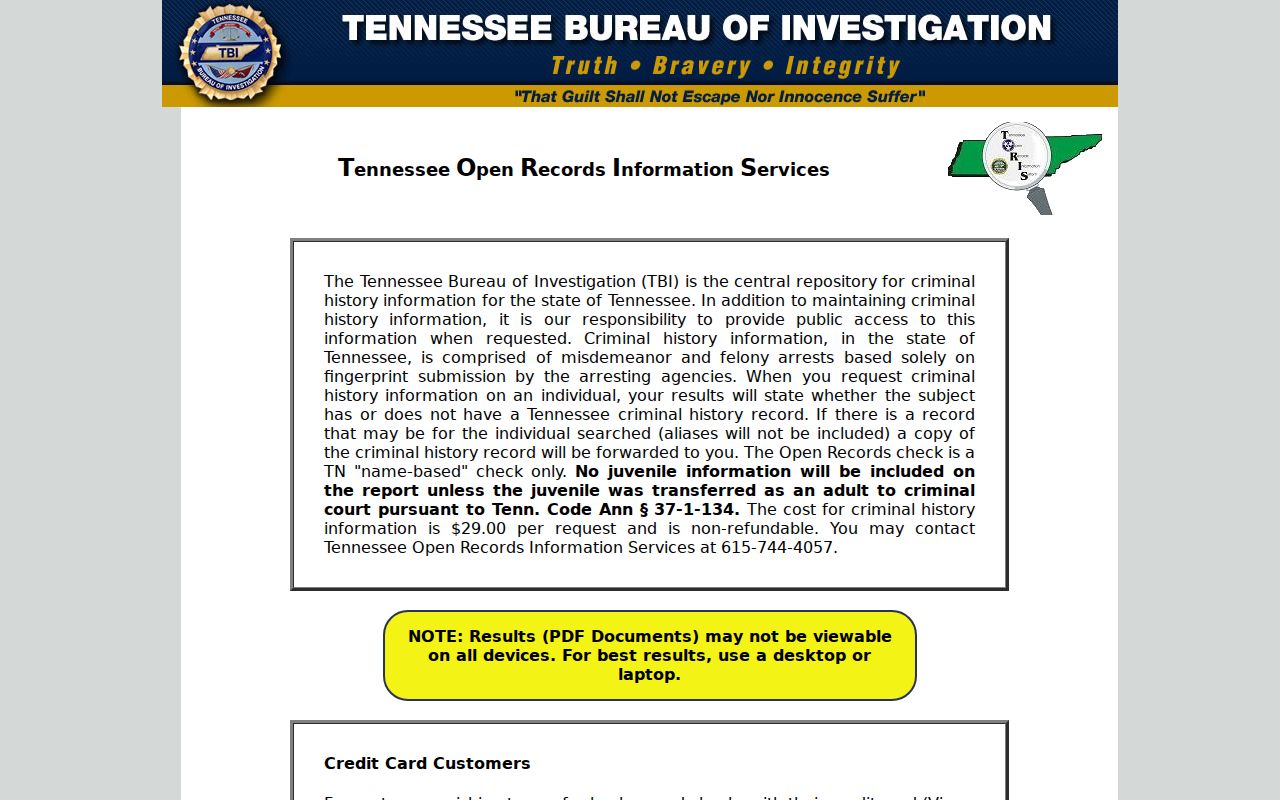
The screen is a state repository doorway, not a complete view of every Williamson court, police, or jail record.
Accurate subject details matter. The request uses the subject's first and last name, date of birth, and optional descriptive data, while the web setup also collects the requester's name, address, phone, email, and payment route. A possible match is not a finding that the named person is the same individual. TBI also warns that result PDFs may display better on a desktop or laptop.
The TN-FlexCheck requestor screen records the details used to deliver and account for the request.
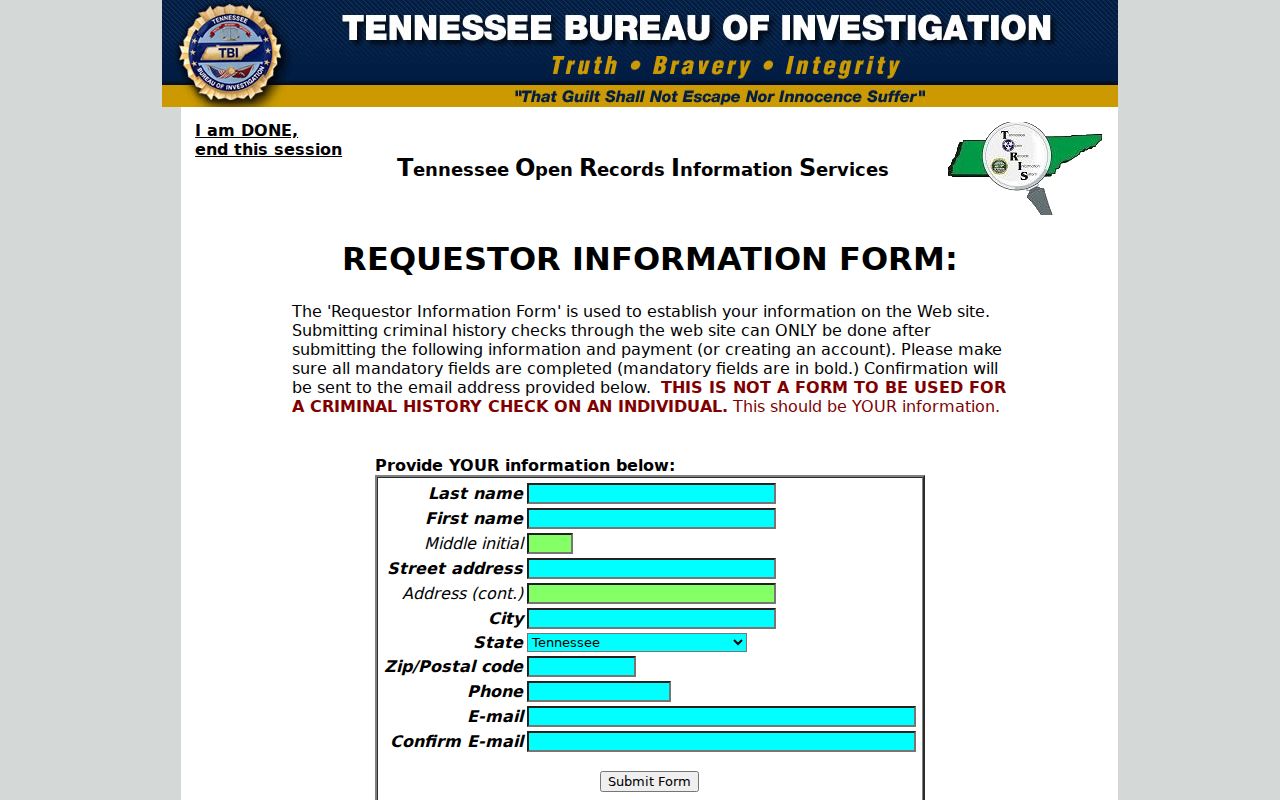
Those requestor fields are separate from the subject identifiers used for the actual criminal-record comparison.
| Field | Use | Important Detail |
|---|---|---|
| First and last name | Subject match | Both are expected; aliases are not searched |
| Date of birth | Narrows identity | Supply the exact date when known |
| Middle name or initial | Separates common names | Optional or unspecified |
| Requestor email | Confirmation and delivery | Must be confirmed on web setup |
| Payment path | Submits order | Credit card or billable account |
Note: Visa, MasterCard, and Discover are accepted on the public credit-card route, while the $29 request remains nonrefundable.
Criminal Record Types
Williamson County criminal records are defined by who made them and what they prove. Incident reports contain officer observations, locations, people, vehicles, and evidence. Booking records document the intake event. Warrants authorize custody or arise from court action. Charging records show the complaint, indictment, or count pursued. Court files contain the docket and final orders. Supervision and registry records answer still different questions.
Juvenile, sealed, expunged, victim-protected, and security-sensitive data may be withheld even when the rest of a record is open. The absence of a public result does not prove the event never happened. It may reflect jurisdiction, timing, a lawful restriction, or the fact that the user searched the wrong custodian.
- Incident and arrest reports: held by the investigating sheriff, city police, or other arresting agency.
- Booking records: held by Williamson County jail staff after local custody intake.
- Court case files: held by the Circuit Court Clerk for Circuit and General Sessions matters.
- TBI history: built from fingerprint-reported Tennessee arrest cycles and later reported outcomes.
- Custody and supervision: split among the county jail, local probation, and TDOC systems.
Williamson Criminal Records at Judicial Center
The practical court-record counter is the Williamson County Judicial Center at 135 Fourth Avenue South in Franklin. The Circuit Court Clerk serves both Circuit and General Sessions records there, Monday through Friday from 8:00 a.m. to 4:30 p.m. The main clerk number is 615-790-5454. Circuit Criminal handles indictments, felony trial dockets, lower-court appeals, and transfers. General Sessions handles many warrants, preliminary matters, misdemeanors, and traffic cases.
The free local Online Court Records System covers selectable Circuit Court and General Sessions Criminal files. It requires a CAPTCHA and at least one court or case-type selection. A name, year, or numeric case suffix can narrow results. Tennessee's State Courts Public Case History is appellate only, so it cannot be treated as a statewide trial-court search for a new Williamson prosecution.
Williamson Circuit Court Clerk
135 Fourth Avenue South
Franklin, TN 37064
615-790-5454
Weekdays, 8:00 a.m.-4:30 p.m.
Sheriff and Detention
408 Century Court
Franklin, TN 37064
615-790-5560
Public office weekdays, 8:00 a.m.-4:00 p.m.
Current courthouse facilities are under review. A county task force created in March 2026 is studying space, parking, and administrative needs, but the cited clerk and court channels remain the documented starting point.
Inside a Williamson County Criminal Record
Read the field in the context of its source. A charge describes an allegation. A disposition records what happened to a count. A sentence follows a conviction or other qualifying outcome. Bond concerns release and appearance while a matter is pending. Names, aliases, dates of birth, case numbers, and agency identifiers help distinguish one event and one person from another.
| Name and Identifiers | Legal name, aliases when held, date of birth, and agency or court numbers. |
|---|---|
| Arrest and Booking | Arrest date, agency, intake time, booking charge, bond, hold, and release status. |
| Charges and Statutes | Alleged offense, count, Tennessee citation, and felony or misdemeanor class. |
| Disposition | Dismissal, nolle prosequi, plea, acquittal, conviction, diversion, or other result. |
| Sentence | Confinement, probation, fines, costs, restitution, and related orders when public. |
| Custody or Supervision | County custody, TDOC status, probation, parole, location, or release data. |
- Disposition
- The recorded outcome of a charge or case, not merely its current filing status.
- Nolle prosequi
- A prosecutor's formal choice not to proceed with a count at that time.
- Capias
- A court writ directing officers to take a person into custody, often after nonappearance or noncompliance.
- Judicial diversion
- A Tennessee route that delays judgment while conditions are completed and may support later expungement.
For a reliable reading, follow each count separately and use the latest signed order. One case can contain several charges with different outcomes, so the case-level status alone may hide a dismissal, plea, or amendment that applies to only one count.
Williamson Jail and Supervision Records
Williamson County does not publish a verified public online jail roster in the official sources reviewed. The sheriff's detention channel directs callers to 615-790-5570 to ask who is held and obtain charge, bond, and release basics. Booking information is also available around the clock through 615-790-5560. Intake may take several hours because fingerprints and the photograph must be completed before bond can be made.
State and local systems answer other questions. TDOC Felony Offender Information Lookup, or FOIL, covers people currently or formerly in state felony custody or supervision. VINE provides custody notifications. Williamson General Sessions Adult Probation holds its own local operational files and publishes reporting forms and program resources. The sentencing order remains the best public proof of what supervision the court imposed.
The official TDOC FOIL explanation distinguishes felony-offender search data, MyTN access, VINE, and parole resources.
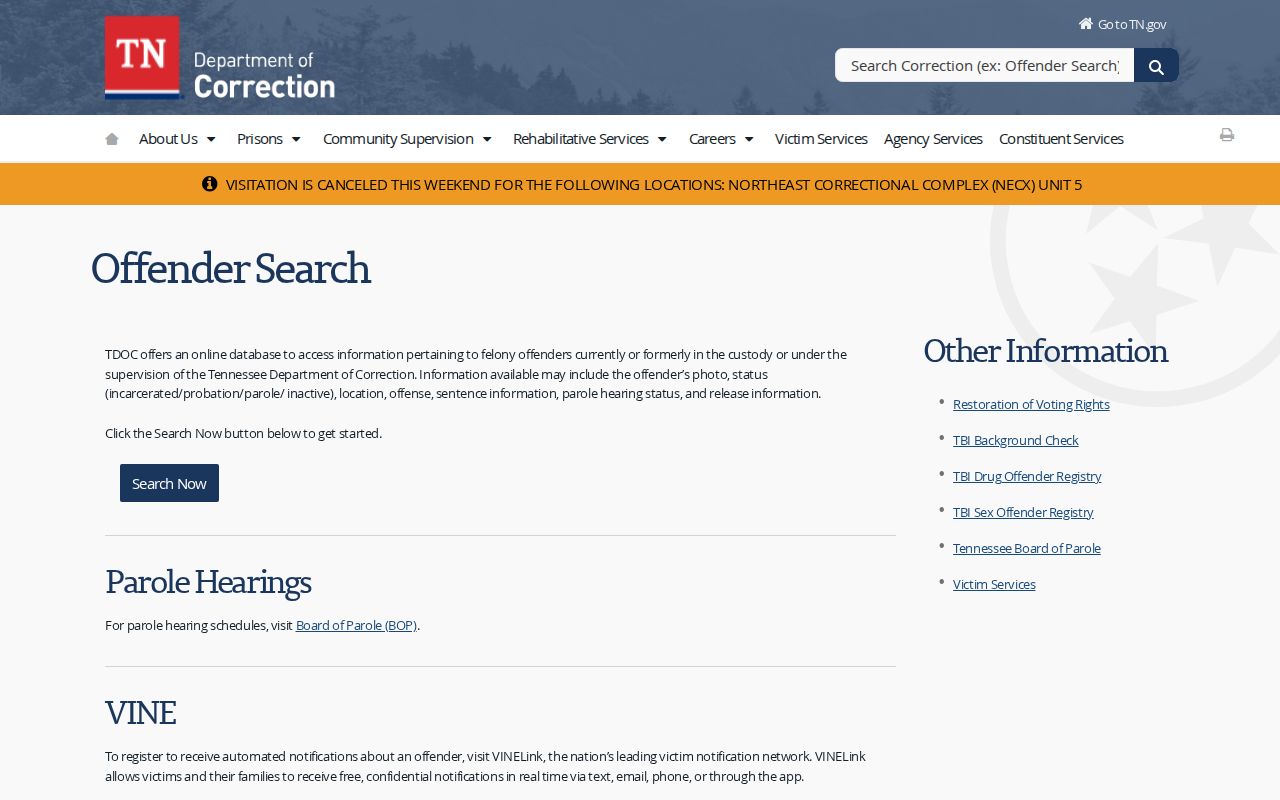
That guidance helps prevent a county booking question from being sent to a state-prison search.
The FOIL search interface can show status, location, offenses, sentence, release data, and parole-hearing information when available.
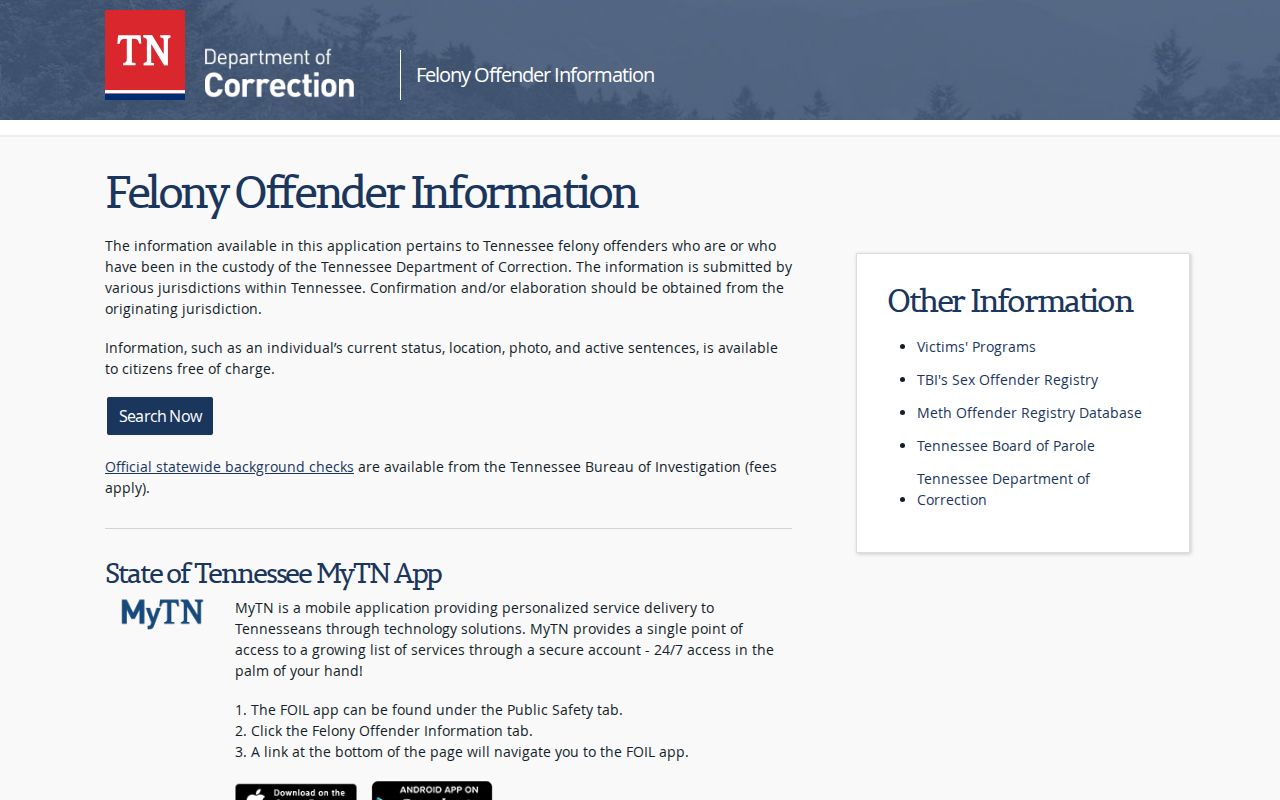
FOIL should be read as a state custody and supervision source, not as a replacement for Williamson County criminal court records.
Public Access Laws in Tennessee
The Tennessee Public Records Act begins with access to existing public records for Tennessee citizens, subject to confidentiality laws and reasonable office rules. It does not compel an agency to research a question or create a new criminal-history report. Williamson County's official request routing page directs administrative requests to the county coordinator, law-enforcement requests to the sheriff or police agency, and city records to that municipality.
Tennessee Supreme Court Rule 34 governs access to court records while protecting confidential material, record integrity, deliberations, and court operations. Juvenile files, sealed or expunged entries, protected victim data, personal identifiers, and active investigative material may be restricted or redacted. Ask for a defined existing record and a cost estimate when a request involves video, extensive redaction, or many pages.
Key Statutes:
T.C.A. § 10-7-503 opens qualifying public records to Tennessee citizens, subject to lawful exceptions.
Tennessee Supreme Court Rule 34 sets the court-record access framework.
T.C.A. § 38-6-120 supports the public TBI criminal-history request carried out through TORIS.
T.C.A. § 40-32-101 creates routes for eligible records to be expunged.
Williamson Warrant Records Require Calls
No verified comprehensive online Williamson County warrant database was found in the official sources. A blank web result does not prove there is no warrant. Ask the Circuit Court Clerk about an already docketed General Sessions or Circuit case. A municipal citation or city matter may require the issuing city court. Sheriff warrant-record questions go through the WCSO records or warrant channel.
The Criminal Warrants and Extraditions line is 615-790-5565. The Magistrates Office at 408 Century Court can be reached at 615-790-5813 and reviews sworn applications for qualifying summonses and warrants. It does not maintain the court docket or change court dates. The sheriff's Wanted Persons publication is supplemental and not a complete live warrant list. A person concerned about their own warrant should contact the proper court and seek legal advice before taking a step that may affect liberty.
The official WCSO warrant-unit page supplies the direct criminal and civil warrant contacts.
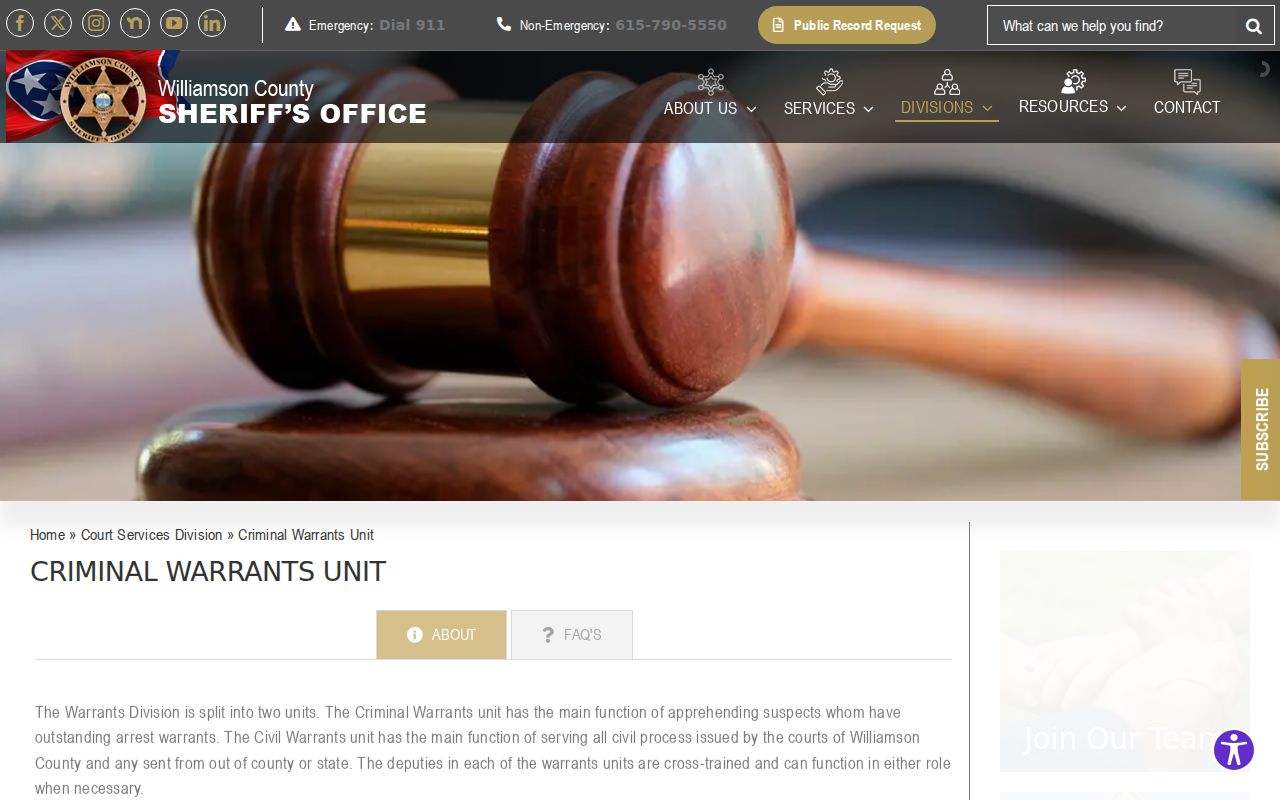
The page also separates civil-process service from criminal warrants, so published civil service charges should never be mistaken for bond amounts.
Sealed, Expunged, and Restricted Records
Tennessee uses both “expunction” in statutes and “expungement” in court-facing material. T.C.A. § 40-32-101 treats non-conviction outcomes differently from the narrow list of convictions eligible for relief. Dismissal, acquittal, no true bill, nolle prosequi, arrest-only outcomes, judicial diversion, prior history, sentence completion, and financial duties can all affect the route. A low offense class alone does not establish eligibility.
Start with the final disposition and case number from the Williamson County Circuit Court Clerk. Compare the actual outcome and offense with current Tennessee court forms. File in the court that holds the case, then keep certified copies of the signed order. Clerks can transmit expungement and disposition data to TBI through Tennessee FlexCheck, but independent police, jail, court, and state systems may update on different schedules.
The Tennessee courts expungement resource provides the official eligibility explanation and forms.
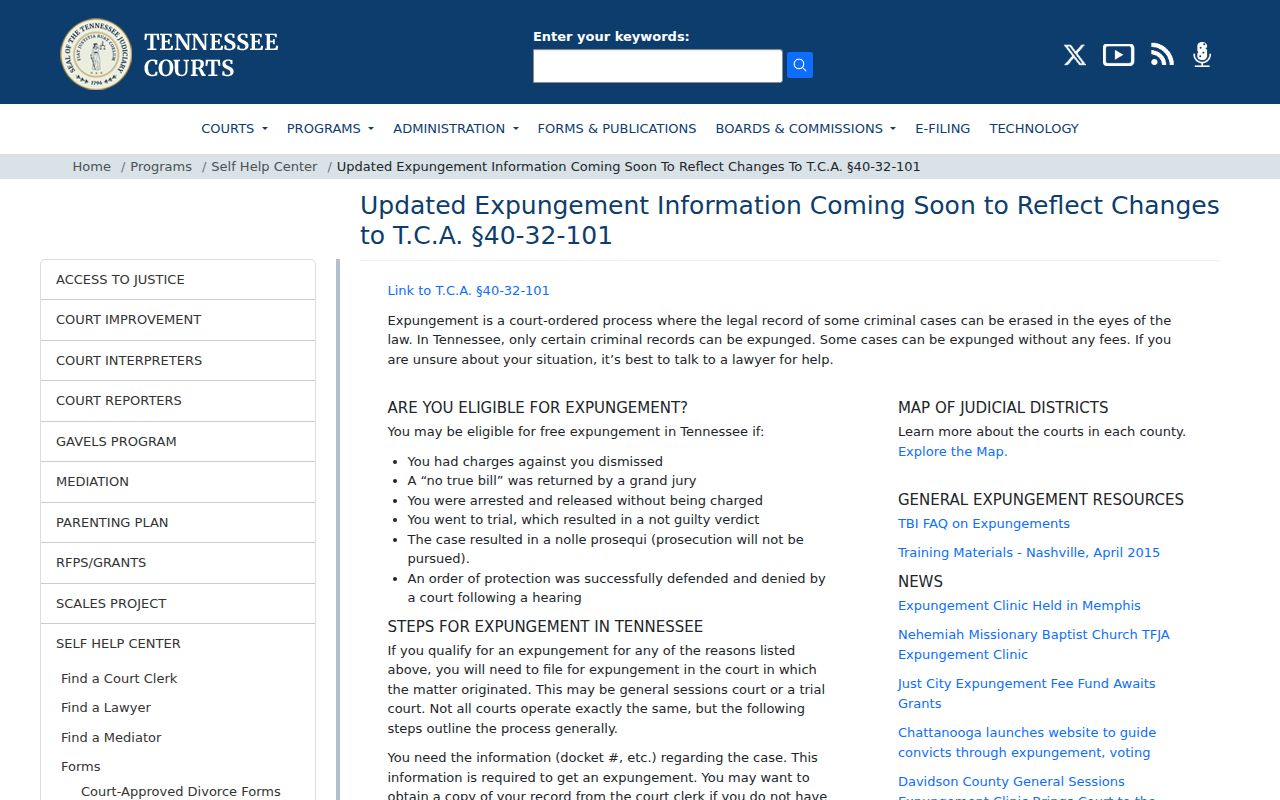
Use the current forms and clerk instructions rather than relying on old fee figures or past versions of the law.
Correcting Williamson Criminal History
When a record looks wrong, first identify which system displays the error. Compare a stale booking or repository entry with the signed court order. If the Williamson docket lacks its final disposition, contact the clerk before asking TBI to change a state result. If TORIS may have matched the wrong person, TBI permits a fingerprint comparison dispute by mail with a letter, fingerprints from a local law-enforcement agency, and the documented $24 payment.
A certified expungement order should be checked against each affected custodian. The court clerk does not directly control a city police report, sheriff booking file, or every repository display. Keep the case number, copy of the order, submission date, and response from each office. That record trail makes it easier to show exactly which entry remains at issue.
Note: A dismissal resolves a court count, but it does not by itself prove that every related public record has already been removed.
Williamson Criminal Record Workload
Local numbers give context without turning counts into claims about people. Tennessee Administrative Office of the Courts data for fiscal year 2024-25 report 3,068 criminal-count filings and 3,341 dispositions in Williamson County. The outcomes included 1,499 dismissal or nolle counts, 1,052 guilty pleas as charged, 149 lesser pleas, 120 diversions, 40 trial convictions, and three acquittals. These are counts, not unique cases or defendants.
The sheriff's 2024 rollup reported 6,879 bookings and 6,924 releases, while monthly average jail population ranged from about 282 to 333. Those figures describe workload and custody events, not a conviction rate. They also explain why booking, clerk, and TBI updates may not appear at the same moment.
Williamson County Criminal Records by City
City police departments keep the incident reports their officers create, and municipal courts keep city citation or ordinance matters. County booking and prosecution records may then appear in separate Williamson systems. Franklin, Spring Hill, and Brentwood are the three largest incorporated cities identified in the research, but Spring Hill crosses into Maury County, so the incident location and assigned court must guide the search.
Franklin Criminal Records
Population estimate 90,226. Franklin Police keeps reports, while city and county courts serve different case levels.
Spring Hill Criminal Records
Population estimate 61,336. Confirm Williamson or Maury County before choosing a jail or clerk.
Brentwood Criminal Records
Population estimate 45,313. Police reports begin with Brentwood, while county cases move to Williamson courts.
Start at city level for the police narrative or municipal citation. Move to Williamson County for local booking, General Sessions, or Circuit records, then use TBI only when the question calls for the statewide repository layer.